Blog
26650 vs 18650 Lithium Battery: Which One Do You Actually Need?
2026-05-02 | Eric
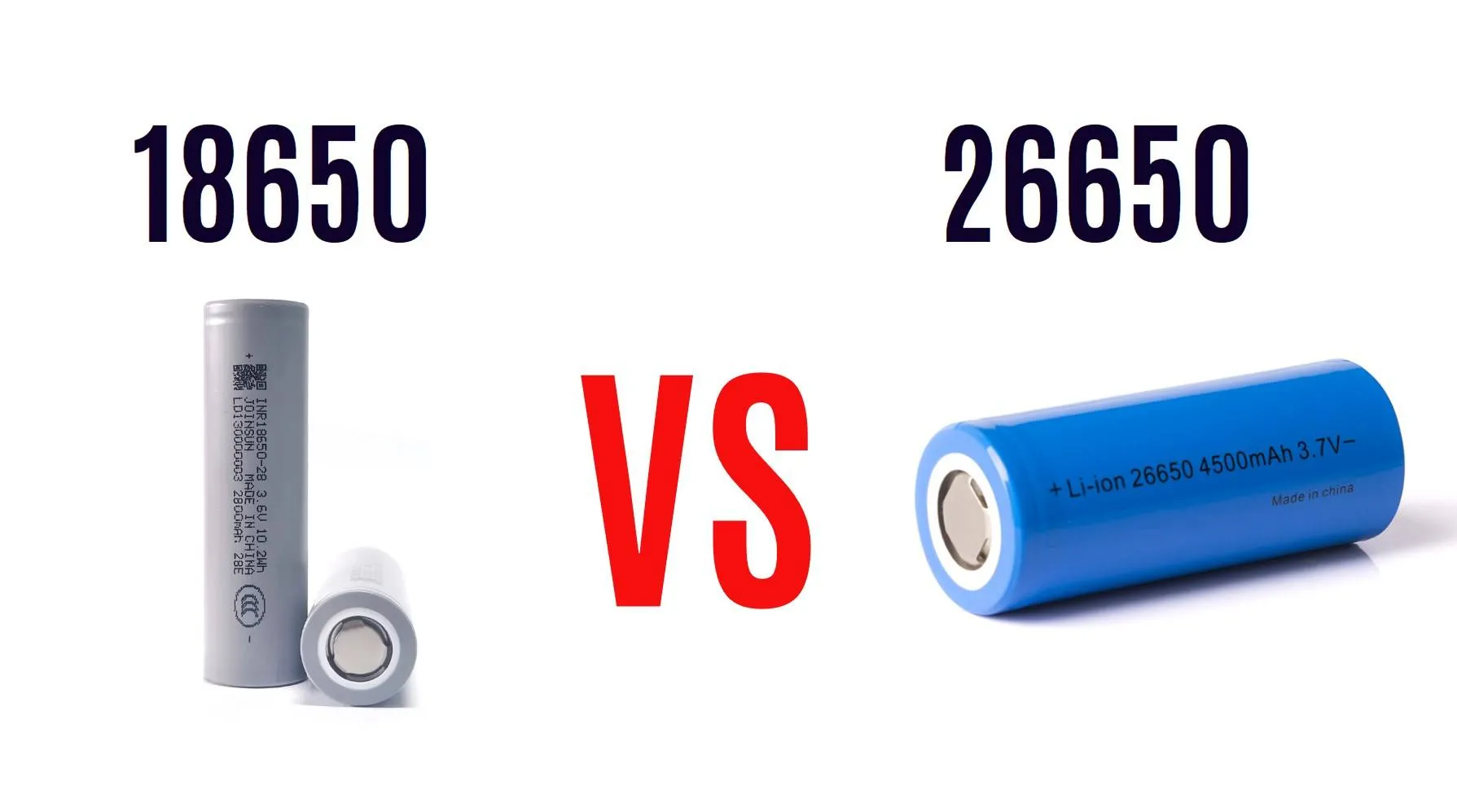
If you’ve been shopping for cylindrical lithium-ion batteries, you’ve almost certainly run into these two names: the 18650 and the 26650. They look similar, carry the same voltage, and are used in many of the same categories of devices. So what’s the real difference — and which one is right for your application?
This guide breaks down every meaningful distinction between the 26650 and 18650 batteries: capacity, energy density, discharge performance, cycle life, compatibility, cost, and ideal use cases. By the end, you’ll know exactly which format to buy.
How Battery Names Work: What ‘26650’ and ‘18650’ Actually Mean
The naming convention for cylindrical lithium-ion batteries is straightforward. Each number encodes the battery’s physical dimensions:
- The first two digits = diameter in millimeters
- The next two digits = length in millimeters
- The final ‘0’ = cylindrical shape
So:
- 18650: 18 mm diameter × 65 mm length
- 26650: 26 mm diameter × 65 mm length
Both batteries are the same height. The key difference is that the 26650 is 8 mm wider — which sounds minor, but translates to significantly more internal volume for active electrode material. That extra volume is the source of most of the performance differences between these two formats.
26650 vs 18650: At-a-Glance Comparison
| Feature | 18650 Battery | 26650 Battery |
|---|---|---|
| Diameter | 18 mm | 26 mm |
| Length | 65 mm | 65 mm |
| Weight | 45–50 g | 80–100 g |
| Nominal Voltage | 3.6–3.7 V | 3.6–3.7 V |
| Capacity Range | 2,000–3,500 mAh | 4,000–5,200 mAh |
| Energy Density | Higher (Wh/kg) | Lower (Wh/kg) |
| Discharge Rate | Moderate | High (better at heavy loads) |
| Cycle Life (typical) | 300–500 cycles | 500–1,000 cycles |
| Availability / Cost | Very widely available, lower cost | Less common, higher cost |
| Best For | Laptops, vapes, flashlights, EVs | Power tools, e-bikes, solar, high-drain flashlights |
Capacity: How Much Energy Can Each Battery Store?
Capacity is measured in milliamp-hours (mAh) and tells you how much energy a battery holds relative to how long it can power a device.
18650 batteries typically deliver between 2,000 mAh and 3,500 mAh, with premium cells from manufacturers like Panasonic, Samsung, and Sony reaching the upper range.
26650 batteries range from 4,000 mAh to 5,200 mAh in standard lithium-ion chemistry, and some LiFePO4 (lithium iron phosphate) variants reach up to 6,000 mAh.
In practical terms: a 26650 cell stores roughly 50–80% more energy than a comparable 18650. For devices where runtime is the priority — extended-use flashlights, power tools operating under sustained load, or solar energy storage — that gap is significant.
Energy Density: Where the 18650 Has the Edge
Energy density is a different metric from raw capacity. It measures how much energy a battery stores relative to its weight (Wh/kg) or volume (Wh/L). This matters in applications where every gram or millimeter of space counts.
Despite having lower absolute capacity, the 18650 actually wins on energy density. Its smaller form factor means the ratio of energy to weight or size is more favorable. This is why the 18650 remains the default choice in laptops, portable electronics, and applications where minimizing weight and form factor is critical.
The 26650, while packing more total energy, is bulkier and heavier. Weighing in at 80–100 grams vs. 45–50 grams for the 18650, the tradeoff is clear: you get more capacity, but you carry more weight to get it.
Discharge Rate and High-Drain Performance
Discharge rate refers to how fast a battery can release its stored energy, typically measured as a C-rating or in amperes. High-drain applications — power tools, e-bikes, sub-ohm vaping, high-lumen tactical flashlights — demand batteries that can deliver large current without overheating or experiencing significant voltage sag.
The 26650 has a structural advantage here. Its larger internal surface area allows for greater current flow with less heat generation. In high-drain scenarios, this means:
- Less voltage sag under heavy load
- Lower internal resistance at sustained discharge
- Better thermal management during extended high-current use
The 18650 handles moderate discharge rates well and is perfectly capable for most consumer applications. But if you’re running a device that draws consistently high amperage, the 26650 is the more capable cell.
Voltage: Both Are Equal
Both the 18650 and 26650 operate at the same nominal voltage of 3.6–3.7V in standard lithium-ion chemistry. When fully charged, both reach approximately 4.2V. Both discharge down to a cutoff of around 2.5–3.0V.
If your device uses a 26650 LiFePO4 cell specifically, the nominal voltage drops to 3.2V (vs. 3.6–3.7V for NMC/NCA chemistries) — but that’s a chemistry difference, not a size difference.
Bottom line: voltage is not a differentiating factor between these two formats. Any device tolerances or charger profiles will be the same.
Cycle Life: How Long Will Each Battery Last?
Cycle life refers to the number of full charge-discharge cycles a battery can complete before its capacity drops below 80% of its original rating.
18650 batteries typically deliver 300–500 cycles under standard use, with high-quality cells from major manufacturers reaching 500+ cycles.
26650 batteries generally offer longer cycle life, often in the 500–1,000 cycle range — particularly those using LiFePO4 chemistry, which can sustain 2,000+ cycles at 100% depth of discharge.
The longer cycle life of the 26650 makes it a more cost-effective choice for applications that cycle the battery frequently, such as off-grid solar storage or regularly used power tools. The upfront cost is higher, but the cost-per-cycle can be lower over the battery’s lifetime.
Conclusion
The 26650 and 18650 are both excellent cylindrical lithium-ion battery formats — but they’re engineered for different priorities.
Choose the 18650 when you need compact size, wide device compatibility, and proven performance in consumer electronics. Choose the 26650 when you need maximum capacity, better sustained-discharge performance, and longer cycle life in demanding, high-drain applications.
Neither is universally superior. The right battery is the one that matches your device’s specifications and your application’s actual power requirements.
Popular Articles
Contact Details
Worktime :Monday to Friday 9am - 6pm (HKT)
WhatsApp/Wechat/Mobile :+8613645616165
Email : info@lifepo4cellstore.com