Blog
How to Estimate the State of Charge (SOC) of LiFePO4 Batteries
2025-12-17 | Eric
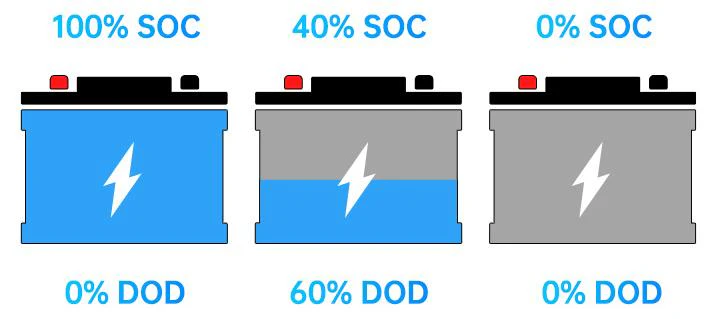
Lithium Iron Phosphate (LiFePO4) batteries are widely recognized for their high energy density, long cycle life, and enhanced safety features. These attributes have made them a popular choice for various applications, from electric vehicles to renewable energy storage systems. However, accurately estimating the State of Charge (SOC) of a LiFePO4 battery remains a challenge for many users, especially in dynamic operating conditions. In this article, we will explore several methods for estimating the SOC of LiFePO4 batteries, and how they can be applied effectively.
1. Estimating SOC Based on Resting Voltage
One of the most straightforward methods for estimating the SOC of a LiFePO4 battery is by measuring its open-circuit voltage (OCV) after allowing the battery to rest for 30 minutes. When a battery is not charging or discharging, its voltage stabilizes, providing a relatively accurate indication of the SOC.
Reference Voltage vs. SOC for LiFePO4 Batteries
The following table outlines approximate voltage readings at different SOC levels for LiFePO4 batteries:
| SOC (%) | Charge Voltage |
|---|---|
| 100% | 13.6V |
| 99% | 13.4V |
| 90% | 13.2V |
| 70% | 13.1V |
| 40% | 13.0V |
| 30% | 12.9V |
| 20% | 12.8V |
| 14% | 12.7V |
| 9% | 12.6V |
| 0% | 10.0V |
While these reference voltages provide a general guideline, slight variations may exist depending on factors such as battery age, temperature, and manufacturer. Therefore, some calibration might be needed to fine-tune voltage readings to match the specific characteristics of a given battery.
Although the resting voltage method is simple and effective, it has a significant limitation: the battery must be at rest for 30 minutes. This makes it impractical for continuous monitoring, particularly in applications where the battery is frequently in use.
2. Alternative SOC Estimation Methods
While the resting voltage method provides a quick estimate of SOC, it doesn't work well under continuous usage conditions. To address this, several alternative techniques can offer more real-time SOC estimation:
a. Coulomb Counting
Coulomb counting is one of the most widely used techniques for SOC estimation. This method integrates the current flowing in and out of the battery over time to track the charge consumed or added. While Coulomb counting provides accurate estimates during usage, it requires precise current measurements and a well-calibrated algorithm to prevent errors from accumulating over time.
b. Impedance Measurement
Another method for estimating SOC is through impedance measurement. This technique relies on measuring the battery's internal resistance or conductivity, which correlates with the state of charge. Impedance-based methods can be highly accurate but often require specialized hardware and may be affected by factors like temperature and battery age.
c. Machine Learning Algorithms
For advanced applications, machine learning (ML) algorithms can be used to estimate SOC based on a wide range of sensor data, including voltage, current, temperature, and impedance. ML models can account for the dynamic behavior of the battery, offering highly accurate predictions. However, implementing such systems requires extensive data collection and sophisticated computational resources.
3. Choosing the Right SOC Estimation Method
Each method for estimating the SOC of a LiFePO4 battery has its advantages and limitations. The most suitable technique will depend on the application’s requirements, including the level of accuracy needed, computational resources available, and whether the battery is in operation or resting.
- Resting voltage is ideal for static conditions and when a quick estimate is required.
- Coulomb counting is best for real-time operation where the battery's charge and discharge patterns are monitored.
- Impedance measurement and machine learning models provide highly accurate estimates, but they require additional hardware and computational resources.
Conclusion
Accurately estimating the State of Charge (SOC) of a LiFePO4 battery is crucial for ensuring efficient and safe battery operation. The resting voltage method offers a simple, cost-effective approach for general applications, while more advanced techniques like Coulomb counting and impedance measurement can offer continuous and real-time monitoring.
When selecting a method, it’s important to balance accuracy, cost, and computational needs to suit the specific application. Proper SOC estimation not only enhances performance but also extends the lifespan of LiFePO4 batteries, making them a more reliable and sustainable energy solution.
Popular Articles
Contact Details
Worktime :Monday to Friday 9am - 6pm (HKT)
WhatsApp/Wechat/Mobile :+8613645616165
Email : info@lifepo4cellstore.com