Blog
Understanding LiFePO4 Battery Temperature Range: Performance, Benefits, and Considerations
2025-12-16 | Eric
LiFePO4 batteries, also known as Lithium Iron Phosphate batteries, have gained significant popularity for their safety, longevity, and lightweight design. However, one common question that many users have concerns the temperature range at which these batteries perform optimally. Understanding how temperature affects LiFePO4 batteries is crucial for maximizing their efficiency and ensuring long-term performance, especially in demanding environments.
What is the LiFePO4 Battery Temperature Range?
The LiFePO4 temperature range refers to the temperatures at which the battery can operate while maintaining reliable performance. Generally, the ideal operating temperature range for LiFePO4 batteries is between -20°C to 40°C. This range ensures that the battery delivers optimal discharge performance.
However, when the temperature drops below 0°C, charging these batteries becomes problematic. Lithium-ion batteries, including LiFePO4 types, cannot safely recharge at temperatures below 0°C, which is often cited as a limitation. To mitigate this, users typically employ either battery heaters or store the battery in a controlled temperature environment.
How Does LiFePO4 Battery Perform in Different Temperature Ranges?
LiFePO4 batteries exhibit varying capacity and voltage performance across different temperature ranges. These two parameters are particularly important for users who rely on the battery for energy storage or electric vehicle (EV) applications.
1. Capacity at Different Temperatures
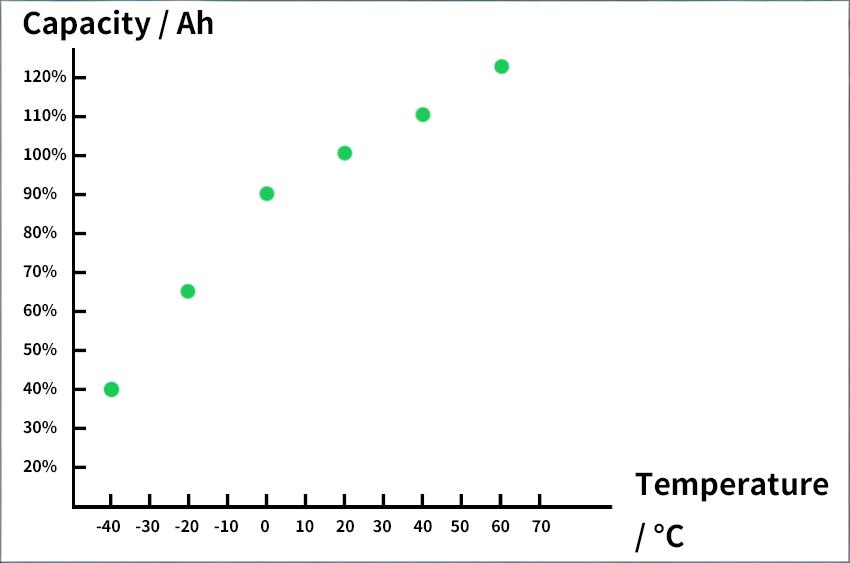
Capacity, which refers to the amount of energy the battery can store and deliver, is one of the most important performance metrics for LiFePO4 batteries. The capacity of LiFePO4 batteries is highly dependent on temperature.
- Above 10°C: The battery performs optimally. The capacity reaches its rated value at 15°C and slightly exceeds the rated capacity at 25°C, which is considered room temperature.
- 40°C: At higher temperatures, LiFePO4 batteries can deliver up to 120% of their rated capacity, enhancing performance for applications requiring higher power output.
- Below 0°C: As temperatures drop, battery performance degrades. At -20°C to -40°C, the capacity can fall to around 60% to 40% of the rated value. This decline is expected in most battery chemistries, but it is more pronounced in LiFePO4 batteries at extreme cold temperatures.
Thus, while LiFePO4 batteries offer impressive performance at moderate to high temperatures, they are less effective in extremely cold environments, making them less suitable for cold-weather applications without additional temperature management.
2. Voltage Fluctuations Across Temperature Ranges
While the nominal voltage of LiFePO4 batteries is typically 3.2V, this value can fluctuate with changes in temperature and state of charge (SOC).
- 50% SOC: The voltage remains stable between 3.2V and 3.3V across the temperature range of -20°C to 50°C.
- Lower SOC (e.g., 15%): At lower charge levels, particularly at -20°C, the voltage can dip as low as 3.0V, and may only stabilize around 3.2V at room temperature.
This indicates that LiFePO4 batteries with low SOC are more sensitive to temperature fluctuations, which can affect their ability to provide consistent power output in demanding conditions.
How Temperature Affects LiFePO4 Batteries in Real-World Applications
The impact of temperature on LiFePO4 batteries is especially relevant for different use cases, such as energy storage or electric vehicles (EVs).
- Energy Storage: For stationary applications like home energy storage, the temperature effect is less critical. Energy storage systems typically do not require frequent cycling, so minor performance degradation due to temperature changes is manageable.
- Electric Vehicles (EVs): For EVs, temperature plays a much more significant role. The loss of capacity and voltage fluctuations at low temperatures can lead to reduced driving range and slower charging, which is a substantial concern for users in colder climates.
Best Practices for Managing LiFePO4 Battery Temperature
To ensure the best performance and longevity of your LiFePO4 battery, follow these best practices:
- Avoid Extreme Cold: Try to avoid using LiFePO4 batteries in temperatures below 0°C for charging. If you need to use the battery in cold environments, consider using a battery heater or store the battery in a controlled temperature environment.
- Monitor Battery Temperature: Implement temperature monitoring systems, especially if you are using the batteries for electric vehicles or critical applications where performance consistency is key.
- Use for Moderate to High Temperatures: LiFePO4 batteries perform best at 10°C to 40°C, so whenever possible, keep the battery in this range to maximize its capacity and voltage stability.
- Regular Maintenance: Regularly check the SOC (state of charge) and voltage of the battery, especially if the temperature fluctuates, to ensure the battery is operating within its optimal parameters.
Conclusion
Understanding the LiFePO4 temperature range is key to maximizing the performance and lifespan of your battery. While LiFePO4 batteries are well-regarded for their safety, longevity, and lightweight design, their performance can be affected by temperature extremes. By knowing the ideal operating conditions and taking steps to manage temperature, you can ensure your LiFePO4 battery delivers the best performance for your application, whether in energy storage systems, electric vehicles, or other power solutions.
Popular Articles
Contact Details
Worktime :Monday to Friday 9am - 6pm (HKT)
WhatsApp/Wechat/Mobile :+8613645616165
Email : info@lifepo4cellstore.com