Blog
How to Do LiFePO4 Battery Balancing: A Complete Guide
2025-10-06 | Eric
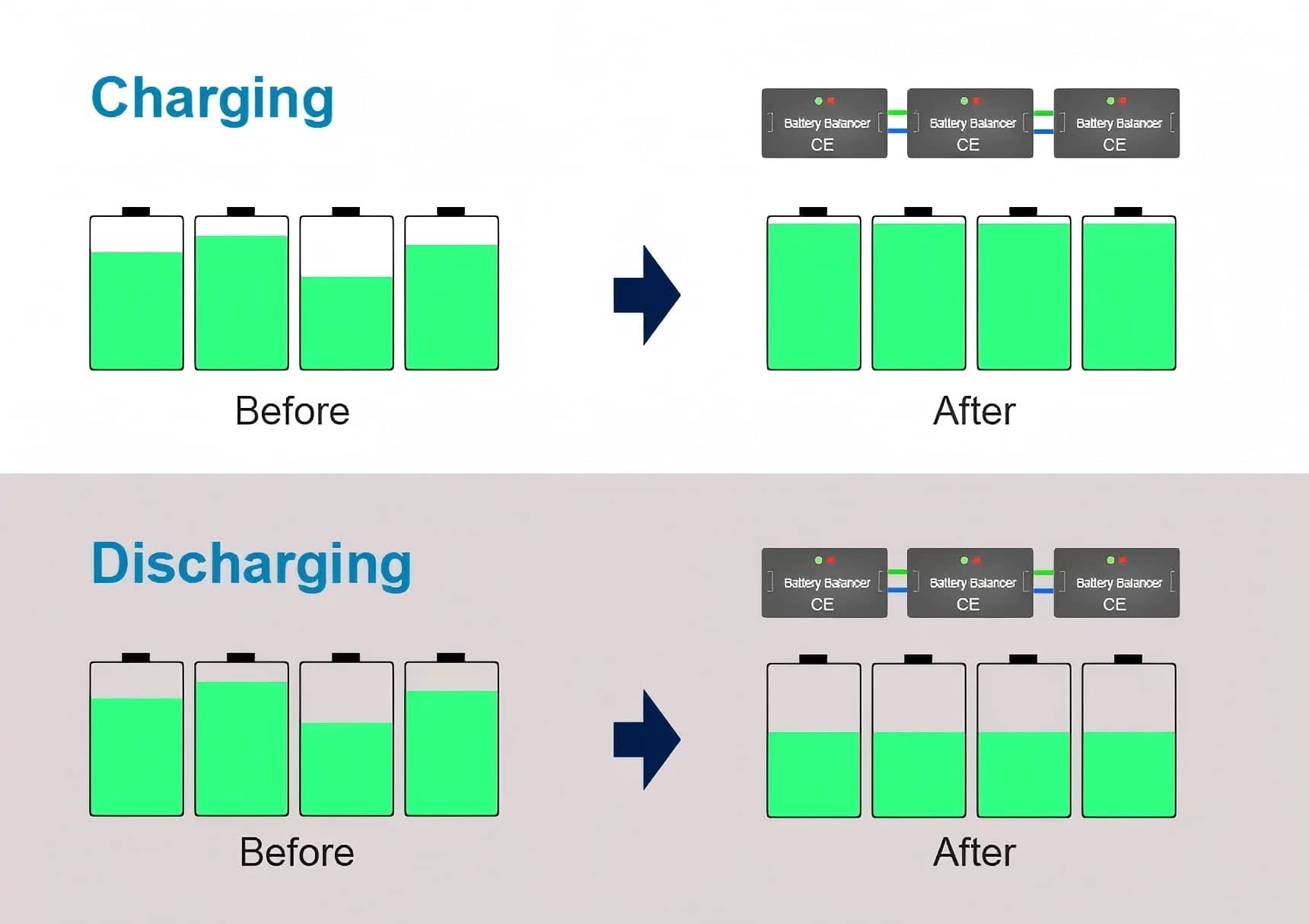
LiFePO4 battery balancing is a critical step in ensuring your battery pack performs safely and efficiently over time. Whether you're assembling a DIY energy storage system or managing a commercial application, proper balancing can dramatically improve the lifespan, reliability, and performance of your LiFePO4 (Lithium Iron Phosphate) battery pack.
Table of Contents
- Why Does LiFePO4 Battery Balancing Matter?
- What Is LiFePO4 Battery Balancing?
- How to Perform LiFePO4 Battery Balancing (Step by Step)
- Role of BMS in Battery Balancing
- Conclusion
Why Does LiFePO4 Battery Balancing Matter?
Each LiFePO4 battery pack is composed of multiple individual cells connected together. While these cells may appear identical, they often come with slight differences in voltage, capacity, and internal resistance due to manufacturing variances, shipping conditions, or storage time.
Without balancing, these inconsistencies can worsen over time, leading to:
- Uneven charging and discharging
- Reduced overall capacity
- Risk of overcharging or over-discharging
- Permanent cell damage or safety hazards
Important: In an unbalanced battery pack, the weakest cell determines the usable capacity, and the strongest cell limits the overall voltage range. This is often referred to as the "barrel effect" in battery systems.
To ensure consistent performance and safety, battery balancing is essential—especially for larger or high-performance packs.
What Is LiFePO4 Battery Balancing?
Battery balancing is the process of equalizing the voltage and state of charge (SoC) of all cells within a pack. The goal is to ensure that:
- All cells charge and discharge at the same rate
- No cell is overcharged or over-discharged
- The battery pack performs as a unified, stable system
There are two main balancing strategies:
- Top Balancing: Balance cells when fully charged
- Bottom Balancing: Balance cells when fully discharged
How to Perform LiFePO4 Battery Balancing (Step by Step)
Option 1: Using a Dedicated Battery Balancer (Recommended)
The most efficient and accurate way to balance LiFePO4 cells is by using a dedicated battery balancer. This device continuously monitors and equalizes cell voltages, offering hands-free maintenance and long-term protection.
Many modern Battery Management Systems (BMS) include built-in balancing functions, but external balancers often provide higher accuracy.
Option 2: Manual Cell Balancing (DIY Approach)
If you don’t have access to a balancer, you can perform manual balancing using the parallel method. Here’s how:
🧰 Tools Required:
- A reliable digital multimeter
- Cables for parallel connection
🛠️ Steps:
- Measure Cell Voltages
Use a multimeter to check and record the voltage of each individual cell. - Sort the Cells
Arrange cells in order from lowest to highest voltage (or vice versa). - Connect Cells in Parallel
Wire all cells in parallel. This allows higher-voltage cells to discharge slightly into lower-voltage cells, gradually equalizing charge levels. - Wait for Voltage Convergence
Leave the cells connected for several hours or even days until all voltages are nearly identical (within 0.01V). - Verify Balance
Re-measure the voltage of each cell. If needed, repeat the process. - Choose Top or Bottom Balancing
- Use top balancing if your system is optimized for full charge operations.
- Use bottom balancing if your system regularly operates at low voltage.
⚠️ Note: Never connect unbalanced cells in series—it can be dangerous and cause permanent damage.
Role of BMS in Battery Balancing
A high-quality Battery Management System (BMS) does more than just protect against overcharge, over-discharge, and overcurrent. It also:
- Monitors individual cell voltages
- Provides passive or active balancing
- Helps maintain balance over the long term
For large-scale or mission-critical applications, pairing a BMS with a standalone active balancer can deliver optimal safety and performance.
Conclusion
Proper LiFePO4 battery balancing is a crucial but often overlooked step—especially among DIY users. Whether you use a manual method or a dedicated balancer, ensuring that your cells are in balance will:
- Maximize the capacity and performance of your battery pack
- Prevent premature cell failure
- Enhance overall safety
- Extend the lifecycle of your system
Popular Articles
Contact Details
Worktime :Monday to Friday 9am - 6pm (HKT)
WhatsApp/Wechat/Mobile :+8613645616165
Email : info@lifepo4cellstore.com