Blog
The Ultimate Guide to NMC Batteries
2026-02-01 | Eric
People often compare NMC and LFP batteries, and we’ve also written a detailed comparison. In this article, we delve into the types, safety, performance, usage environment, and market trend of lithium NMC batteries. Let’s start!
Table of Contents
- What Does NMC Stand for in Batteries?
- Different NMC Battery Types
- NMC Battery Voltage and Discharge Curve
- NMC Battery Energy Density and Cycle Life
- NMC Battery Safety
- Advantages and Disadvantages of NMC Batteries
- Wide Applications of NMC Batteries
- The Future of NMC Battery Technology and Market Trends
- Conclusion
- FAQs About Lithium NMC Batteries
What Does NMC Stand for in Batteries?
NMC stands for Nickel Manganese Cobalt, referring to a lithium-ion battery whose cathode material consists of a combination of nickel (Ni), manganese (Mn), and cobalt (Co). This composition provides an excellent balance of energy density, cycle life, and thermal stability, making NMC batteries widely used in industries such as electric vehicles (EVs), robotics, and marine applications.
Composition of NMC Batteries
Cathode: The cathode of an NMC battery consists of compounds of nickel, cobalt, and manganese. The specific ratio of these metals influences the battery's energy density, stability, and overall performance.
Anode: Graphite is commonly used for the anode, providing excellent lithium-ion insertion properties.
Electrolyte: Lithium salt, such as LiPF6, is used as the electrolyte, enabling lithium ion movement between electrodes during charging and discharging.
Separator: A microporous membrane made from polypropylene (PP) or polyethylene (PE) isolates the electrodes, preventing short circuits while allowing ions to pass through.
Different NMC Battery Types
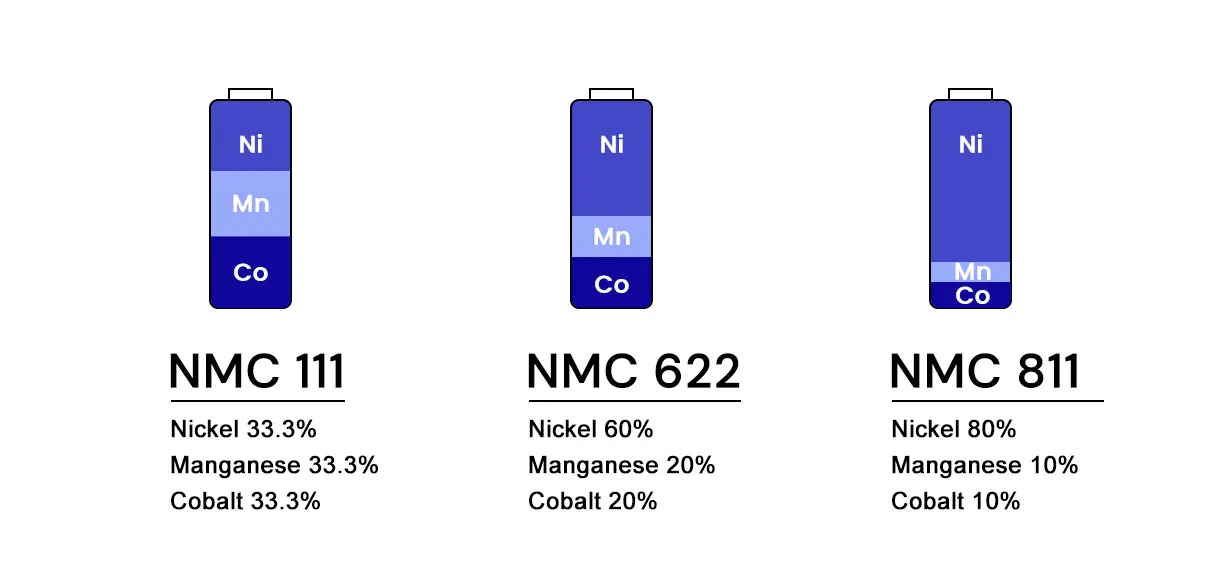
NMC batteries are classified based on the ratio of nickel, manganese, and cobalt. Here are the key types:
- NMC 111 (1:1:1 ratio): A balanced option for energy density and safety with a relatively low energy density (~160 Wh/kg) and long cycle life (1,000-2,000 cycles).
- NMC 532 (5:3:2 ratio): Offers better energy density (~180 Wh/kg) and safety than high-nickel types, suitable for cost-sensitive EVs.
- NMC 622 (6:2:2 ratio): Strikes a balance between performance and cost with energy density exceeding 200 Wh/kg, once a popular choice for EVs.
- NMC 811 (8:1:1 ratio): Provides the highest energy density (~250 Wh/kg) but requires better thermal management to prevent overheating, commonly used in premium EVs like the Tesla Model 3.
NMC Battery Voltage and Discharge Curve
Voltage: NMC batteries operate at a nominal voltage of 3.7V, within a range of 3.0V to 4.2V per cell, enabling efficient energy storage and discharge.
Discharge Curve: NMC batteries maintain a stable voltage for a longer time before a sharp decline, ensuring consistent power output during operation.
NMC Battery Energy Density and Cycle Life
Energy Density: NMC batteries offer an impressive energy density of 150–250 Wh/kg, enabling compact designs with longer driving ranges for electric vehicles and enhanced performance in other applications.
Cycle Life: NMC batteries typically achieve 1,000-1,500 cycles, with advanced types reaching up to 2,000-2,500 cycles. Proper charging practices can significantly extend battery life.
NMC Battery Safety
Are NMC Batteries Safe?
NMC batteries can be prone to thermal runaway if overcharged or exposed to high temperatures. However, integrating smart protection systems like battery management systems (BMS) and thermal management technologies can significantly improve safety.
Thermal Runaway: This is a risk when a battery's internal temperature rises uncontrollably, potentially leading to fire or explosion. Proper charging and temperature management are crucial to preventing this.
Safety Recommendations:
- Use quality batteries and smart BMS to prevent overcharging.
- Implement thermal management to regulate temperatures.
- Avoid charging in extreme heat or leaving batteries exposed to direct sunlight.
Advantages and Disadvantages of NMC Batteries
Advantages:
- High energy density (200-350 Wh/kg).
- Fast charging capabilities.
- Reliable low-temperature performance.
- Long cycle life (1,500-2,000 cycles).
Disadvantages:
- High production costs due to expensive materials (nickel, cobalt).
- Safety concerns with thermal stability, especially at high nickel content.
- Limited tolerance to high temperatures (above 60°C), reducing lifespan and performance.
Wide Applications of NMC Batteries
Electric Vehicles (EVs): NMC batteries' high energy density and long cycle life make them ideal for powering electric vehicles, providing long driving ranges and rapid charging capabilities.
Robotics: High energy density and compact design make NMC batteries perfect for powering robots, ensuring sustained performance for complex operations like walking, grasping, or performing backflips.
Marine Applications: Used in electric boats and trolling motors, NMC batteries provide a reliable power source for long-term navigation.
Solar Energy Systems: NMC batteries efficiently store energy from solar panels during the day and release it at night, offering a sustainable power solution for solar energy storage.
The Future of NMC Battery Technology and Market Trends
The global NMC battery market is projected to grow significantly, from USD 35.6 billion in 2025 to USD 123.4 billion in 2034. With a growing demand for high-performance batteries in industries like EVs, robotics, and energy storage, the future of NMC technology is centered on further improvements in energy density, safety, and cost reduction. The trend toward high-nickel chemistries is expected to continue as manufacturers strive to meet the demand for longer driving ranges in electric vehicles.
Conclusion
NMC batteries are essential to modern technologies, offering high energy density, fast charging, and long cycle life. They play a vital role in applications ranging from electric vehicles to solar energy storage. However, challenges such as thermal stability and cost remain, emphasizing the need for advanced safety systems and innovation in battery design.
FAQs About Lithium NMC Batteries
What is the typical lifespan of an NMC battery?
NMC batteries typically last between 1,000-2,500 cycles, depending on usage and charging practices.
Why is NMC battery chemistry important?
The combination of nickel, manganese, and cobalt in varying ratios determines the battery’s energy density, thermal stability, and cycle life.
Are NMC batteries safe to use in electric vehicles?
Yes, with proper battery management systems (BMS) and thermal management technologies, NMC batteries are safe for use in electric vehicles.
How does the energy density of NMC compare to other battery types?
NMC batteries offer higher energy density than many other lithium-ion chemistries, making them ideal for applications requiring compact design and long battery life.
What are the main applications of NMC batteries?
NMC batteries are widely used in electric vehicles, robotics, solar energy storage systems, marine applications, and power tools.
Popular Articles
Contact Details
Worktime :Monday to Friday 9am - 6pm (HKT)
WhatsApp/Wechat/Mobile :+8613645616165
Email : info@lifepo4cellstore.com